
Prediction vs Tip: What Each Term Actually Means
 Available in US
Two words people use as if they were the same thing
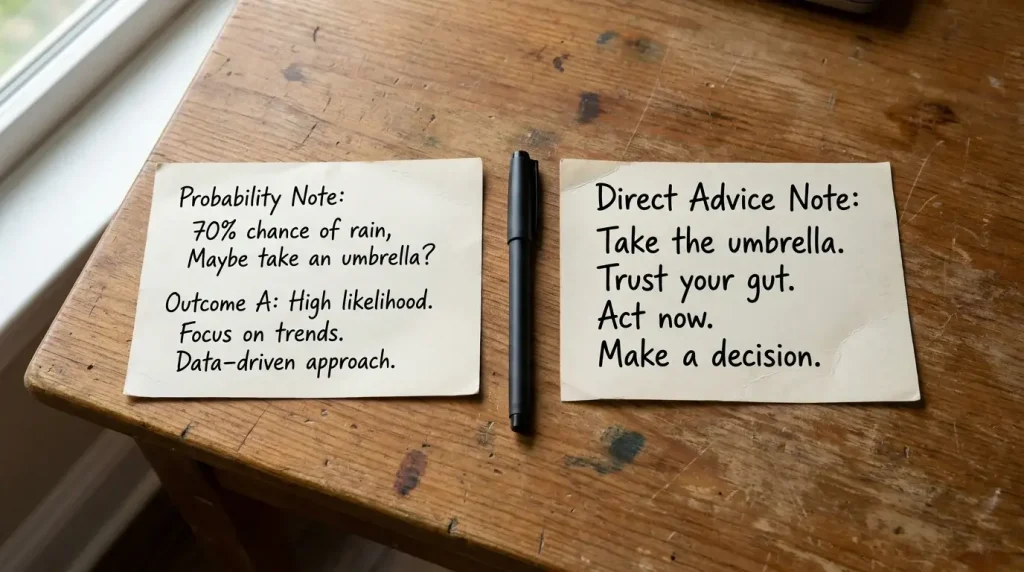
I get asked for “a tip” and “a prediction” interchangeably all day, and the two words are doing very different jobs even though the people using them rarely notice. A prediction tells you what is likely to happen. A tip tells you what to bet on. They overlap, but the gap between them is where a lot of confusion and a fair amount of lost money lives, because treating a prediction as a tip means betting on something that was never meant to be a recommendation.
The cleanest summary I have seen comes from an analytics editorial team, which puts it that the key difference is that anyone can make a prediction, whereas tips are usually given by experts or professionals and are a specific recommendation on what to bet. That distinction sounds small and is actually everything. A prediction is a forecast about reality; a tip is advice about action, and advice carries a standard of accountability that a forecast does not.

So this article pins down what each term genuinely means, why the distinction changes how you should treat the information, and which of the two deserves your trust in which situation.
Defining a prediction
A prediction is, at its core, a statement of likelihood, and the honest ones are explicit that likelihood is all they are. The same analytics editorial framing captures it well: predictions are data-driven forecasts based on statistical models and team form, and they are not guarantees. That last clause is the part people skate over. A prediction that a home win is the most probable outcome is not a promise the home team will win; it is a claim about probability, and probability means it will frequently be wrong even when it is well made.

This is why predictions come in the language of percentages and most-likely outcomes rather than instructions. A good prediction might say a team has a fifty-five per cent chance of winning, which simultaneously tells you it is the favourite and that it will lose almost half the time. The value of a prediction is in its calibration, whether its stated probabilities match reality over many matches, not in whether any single forecast comes true. Judging a prediction by one result is like judging a weather forecast by one rainy day it called at thirty per cent.
The crucial consequence is that a prediction, on its own, is not enough to bet on. Knowing the home team is most likely to win tells you nothing about whether the odds offer value, and value is what determines profit. A prediction is raw information about the world; turning it into a bet requires a second step, comparing that probability against the price, which is precisely the step a tip is supposed to have already taken. Anyone can produce a prediction, because anyone can state what they think will happen. The harder, accountable work begins after that.
Defining a tip
A tip is a recommendation to take a specific bet, and that word “specific” is what raises the stakes. Where a prediction says “this team will probably win”, a tip says “back this team at these odds”, which folds in a judgement about value that the prediction alone never made. A tip is therefore a prediction plus a verdict on the price, and the verdict is where the expertise the analytics teams describe actually shows up.

That is why tips, by convention, come from people or services putting their judgement on the line. The expectation is that a tipster has not only formed a view about the likely outcome but has checked it against the available odds and decided the bet is worth making, which is a higher bar than simply forecasting a result. The recommendation carries an implicit claim that there is an edge here, that the odds are generous relative to the true probability, and a tip that ignores the price is not really a tip at all, just a prediction wearing a recommendation’s clothes.
The accountability difference is real and worth respecting. A prediction can be wrong without anyone losing money, because nobody was told to bet on it. A tip that loses costs the people who followed it, which is why a serious tipster maintains a track record, states the odds at which the bet was advised, and can be judged on long-run profitability rather than just hit rate. When you take a tip, you are outsourcing both the forecast and the value judgement to someone else, so the quality of that person’s process matters enormously. The best tips rest on transparent reasoning you could in principle check; the worst are predictions dressed up as advice, with the crucial value step quietly skipped.
Which to trust, and when
The practical question is which you should rely on, and the answer depends on what you are trying to do. If you want to understand a match, a prediction is the right tool, and you should treat it as exactly what it is: a probability statement to inform your own thinking, not an instruction. If you want a ready-made bet, a tip is what you are after, but only from a source whose value judgement you have reason to trust, because the tip’s worth is entirely bound up in the quality of that hidden second step.

Either way, the underlying difficulty is the same, and the numbers keep everyone honest. The best automated 1X2 forecasting in the Europa League runs at about 62 per cent, and the goals markets such as both-teams-to-score and Over/Under 2.5 both sit around 50 per cent. Whether you call your information a prediction or a tip, it is operating against those ceilings, so anyone offering you certainty in either format is selling something the data says does not exist.
My own advice is to value predictions for understanding and tips for action, but never to confuse the two, and never to bet on a prediction as though someone had told you it was a good bet. The single most useful habit is to do the value step yourself even when following a tip, so you understand why the bet is supposedly worth making rather than taking it on faith. Both forms ultimately live or die by accuracy, and how that accuracy is actually measured and verified is the subject of my detailed breakdown of how accurate Europa League predictions really are.

Can a prediction also be a tip?
Yes, when the person making it adds the missing value step. A prediction states what is likely to happen, while a tip recommends a specific bet at specific odds, so a prediction becomes a tip the moment its author judges the price worth taking and advises you to back it. The distinction is whether the value judgement has been made: a forecast that a team will probably win is only a prediction until someone compares that probability to the odds and turns it into a recommendation.
Are expert tips held to a higher standard?
They should be, because a tip is a recommendation people act on, whereas a prediction can be wrong without costing anyone money. A serious tipster maintains a verifiable track record, states the odds at which each bet was advised, and can be judged on long-run profitability rather than hit rate alone. That accountability is what separates a genuine tip from a prediction dressed up as advice, so the standard you should hold a tipster to is far higher than the one you apply to a simple forecast.
Articles
Created by the "Europa League Prediction" editorial team.
