
Europa League Prize Money: How Finances Shape Predictions
 Available in US
The factor every tipster ignores and I never do
The most useful thing I ever added to my prediction process wasn’t a new model or a fancier dataset. It was a spreadsheet of how much money each round of the Europa League pays out. The first time I overlaid prize money onto a fixture and realised one side had ten million reasons to win and the other had nothing left to play for, I understood something that no goals-per-game table will ever tell you: football is played by clubs, and clubs run on money.
Here’s the figure that frames the whole competition. The total prize pool for the 2025/26 Europa League was around €565 million — roughly 17% of UEFA’s €3.3 billion in club competition revenue. That’s not pocket change to the clubs involved; for many of them, a deep run is the single biggest financial event of their year. And the moment money that large is attached to results, it starts bending behaviour in ways that are entirely predictable if you know where to look — which players a manager rests, how hard a side chases a result, whether a “dead rubber” is actually dead. Almost every prediction site treats every match as a pure contest of ability. The clubs don’t. They’re running businesses, and the prize ladder is the incentive structure those businesses respond to.

This article connects the money to the football. I’ll show you how big the pool really is, how it’s carved up, what the winner actually walks away with, and — the part nobody else covers — how those incentives change the way teams play, especially at the sharp end of the season. Read this and you’ll start seeing fixtures the way the clubs’ accountants do, which is a genuine edge in a field obsessed with form and blind to finance.
The size of the pot and why it matters
When I tell casual fans the Europa League pays out more than half a billion euros, they assume I’ve confused it with the Champions League. They haven’t grasped how much UEFA’s second-tier competition has grown, and that growth is exactly why the financial angle has become so predictive.
The 2025/26 pool stood at around €565 million, and to understand why that number moves teams you have to see it next to the broader picture: UEFA expected roughly €4.4 billion in commercial revenue across its three club competitions that season, with the Europa League’s share representing about 17% of the €3.3 billion in club competition revenue. This is no longer a consolation tournament that clubs amble through. It’s a major revenue stream, and for sides outside the elite of their domestic leagues it can be the difference between a profitable year and a loss, between keeping a key player and selling him. That financial weight is why I stopped treating the Europa League as a competition teams “don’t really care about.” The biggest clubs might rotate in the early rounds, but the money on offer means almost everyone takes it seriously once the knockouts arrive — and seriousness is a predictive variable.
The practical point for prediction is this: the larger and more progressive the prize structure, the more a club’s behaviour is shaped by where it sits on the ladder. A side that’s already banked its participation fee and has nothing further to chase in a given match behaves differently from one staring at a seven-figure jump for winning. The pot is big enough that those jumps are real money, and real money changes team selection, intensity and risk-taking. The size of the pool isn’t trivia — it’s the reason the incentives this whole article rests on are powerful enough to matter.
How the money is carved up
The first time I actually read UEFA’s distribution model, a lot of confusing team behaviour suddenly made sense. The money isn’t handed out as one lump for winning — it’s split into distinct streams, and each stream creates a different incentive. Understanding the carve-up is understanding the motivation map of the entire competition.
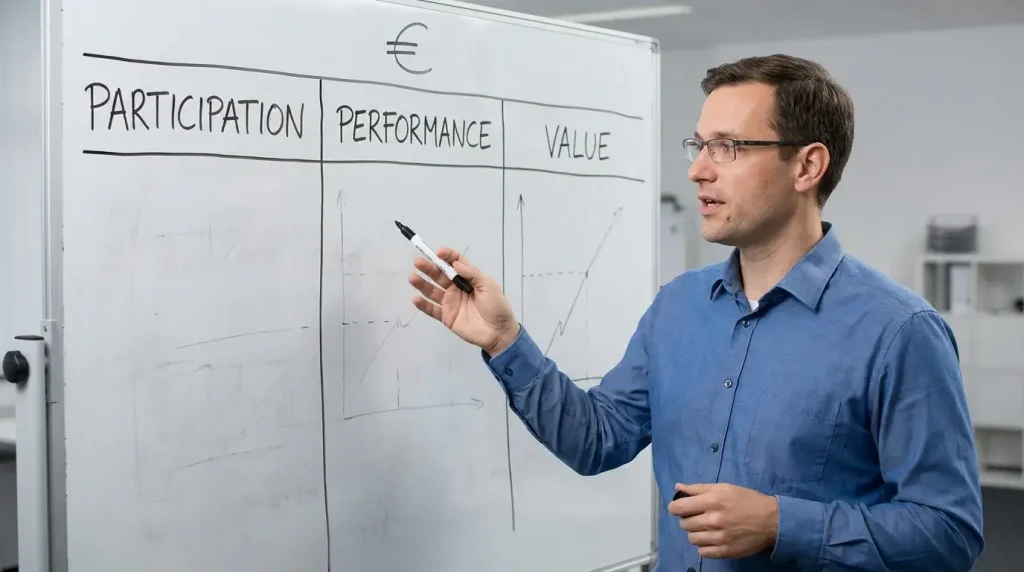
The pool divides into three pillars. Around €155 million, about 27.5%, goes out as equal participation payments — money every qualifying club receives simply for being there. Roughly €212 million, about 37.5%, is tied to sporting performance — results on the pitch. And around €198 million, about 35%, is a “value” pillar based on broadcast market and historical coefficient. That structure matters enormously for prediction because the three streams pull in different directions. The participation money is guaranteed and therefore motivationally neutral — it’s already banked. The performance money is the live wire: it’s the pot that rewards winning specific matches and advancing through specific rounds, and it’s the stream that changes how hard a team tries on a given night.
Zoom into the performance pillar and the incentives get sharp. Each of the 36 league-phase clubs receives a guaranteed €4.31 million just for participating. On top of that, a league-phase win pays €450,000 and a draw €150,000 — meaning the gap between winning and drawing a single group-stage match is €300,000, a sum that absolutely influences whether a manager rotates or fields his strongest side. Then the knockout ladder steepens dramatically: reaching the round of sixteen is worth €1.75 million, the quarter-finals €2.5 million, and the semi-finals €4.2 million. Look at those jumps and you can read the season’s pressure points directly. The leap from the round of sixteen to the quarter-finals alone is €750,000; surviving to the semis adds another €1.7 million. These aren’t abstract numbers to a mid-sized club — they’re the budget for next season’s transfer window, and teams play accordingly.

The value pillar deserves a note too, because it explains why two clubs in the same round don’t necessarily earn the same. That €198 million stream is weighted by factors like broadcast market size and historical coefficient, which means a club from a large television market can bank more from an identical run than a club from a smaller one. For prediction this is a subtler effect than the win bonuses, but it’s real: a side from a major market has even more riding on progression than its on-pitch position alone suggests, because the value payments amplify every round it survives. When I’m weighing how seriously a club is likely to take a given tie, I factor in not just where it sits on the performance ladder but how much its particular market multiplies the reward. The money map isn’t flat across the field — it’s contoured, and the contours tell you whose incentive runs deepest.
What winning it all actually pays
A club chairman once described lifting the Europa League to me as “a season’s worth of revenue in a single trophy,” and the numbers back him up. The headline winner’s payout is the figure that gets quoted, but the way it accumulates is what reveals how the incentives build to a crescendo.
A club that wins every match on its way to lifting the trophy can collect somewhere around £28.6 million in total prize money across the campaign. That figure isn’t a single winner’s cheque — it’s the sum of participation money, win bonuses, and the escalating round-by-round payments stacked on top of each other from the league phase to the final. The reason that distinction matters for prediction is that it tells you the money is earned incrementally, round by round, which means the incentive to win is live at every single stage rather than concentrated only on the final. A club isn’t just playing for a far-off jackpot; it’s playing for a concrete six- or seven-figure payment in the very next tie. That incremental structure is also why you rarely see a genuine “dead rubber” once the knockouts begin — there’s almost always a meaningful payment riding on the next result, so the disengagement that fans assume simply doesn’t materialise the way it might in a competition that paid out only at the end.
And the prize money is only part of the financial picture, which is why the real stakes are even higher than the pool suggests. In the 2024/25 season, the club that earned the most from the Europa League — Tottenham — banked around €46 million, a figure that includes prize money plus the broadcast and market-pool payments that flow from a deep run. When you grasp that a single good European campaign can be worth that much to a club, you stop being surprised by how hard sides fight for it in the closing stages. The trophy is the glory; the €46 million is the reason the boardroom cares, and boardrooms that care lean on managers to field strong teams. For a forecaster, the lesson is that financial upside of this scale removes the “they don’t really want it” discount that fans casually apply — by the knockout rounds, almost everyone wants it badly.

Where money quietly decides matches
The bet I’m proudest of in nine years wasn’t a clever statistical read. It was noticing that a club had already secured its league-phase progression with a match to spare, had a crucial domestic fixture three days later, and was therefore certain to rest half its first team. The “form” pointed one way; the money pointed the other. The money was right. This is the heart of why I track prize money, and it’s the angle no goals table will ever give you.
The mechanism is straightforward once you see it. A team’s motivation in any given match is a function of what’s still financially at stake for it, and that varies wildly across a season. A side fighting to climb into the top eight of the league phase — and skip the extra play-off round — has every reason to go full throttle in its final group matches. A side already mathematically through, with a derby looming at the weekend, has every reason to rotate and protect its key players. The season-long form figures don’t capture that, because form is backward-looking and motivation is forward-looking. When I see a fixture, my first question after “who’s better?” is “what does each side still have to play for, financially and in terms of progression?” The answer reshapes the prediction more often than people would believe.
This effect intensifies brutally in the knockout rounds, and the analysts at Footy Accumulators captured exactly why: teams can afford an off day across an eight-match league phase, but the late two-legged ties leave no room for error. The financial cliff-edge sharpens that. When a quarter-final place worth €2.5 million hinges on a single second leg, a club fields its strongest possible side and plays with an intensity its league form may not predict. The money compresses the variance — sides try harder, rotate less, and behave more like their true quality when the stakes are highest. There’s one more incentive layered on top, and it might be the most powerful of all: the Europa League winner earns a place in the following season’s Champions League league phase. For a club that can’t realistically qualify through its domestic league, that pathway is worth far more than the prize money itself, and it can make a side treat the Europa League as its entire season — a motivation that’s invisible to form but decisive to results. Reading that incentive correctly is also central to predicting who actually goes the distance, which connects directly to how the outright title market should be approached, something I’ve explored in a guide to reading the Europa League winner market.
The commercial machine behind the prize pool
Behind every prize payment is a commercial engine most fans never think about, and understanding its scale explains why the money keeps growing and why clubs keep caring more. The prize pool doesn’t fall from the sky — it’s funded by a vast revenue operation, and that operation has been expanding fast.
UEFA expected around €4.4 billion in commercial revenue across its three club competitions in 2025/26, the engine that funds the prize pools, the participation fees and the value payments across the Champions League, Europa League and the Conference League combined. That figure tells you the direction of travel: as broadcast and sponsorship revenue grows, so do the prizes, and so does the financial incentive for clubs to take the competition seriously. The Europa League of today pays vastly more than it did a decade ago, and that trajectory is precisely why the “they don’t care about it” assumption has aged so badly. The money has grown to the point where clubs can’t afford not to care.
For prediction, the commercial context matters as a trend rather than a single match factor. The larger the financial reward on offer, the stronger and more consistent the motivation effects become, which means the money-and-motivation lens I’ve described isn’t a fading edge — it’s a sharpening one. As the pool grows, the gap in behaviour between a club with everything to play for and a club with nothing left to chase only widens. The commercial machine is the reason this analytical angle keeps getting more useful, not less, and it’s why I expect prize-money awareness to remain one of the most underexploited tools in football prediction for years to come.
Reading the money before you read the form
The shift I want to leave you with is a reordering of how you approach a Europa League fixture. Most punters open with form and never get past it. I open with money — what each side still has to win, financially and in progression — and only then layer the football on top. That single reordering has improved my reads more than any model upgrade.
Carry the structure with you. The pool is large enough to matter — around €565 million in 2025/26 — and it’s carved into participation money that’s motivationally neutral and performance money that’s a live wire. The knockout ladder steepens sharply, from €1.75 million for the round of sixteen up through the semis, so the incentive to win is real at every stage, not just the final. A perfect run pays around £28.6 million, and a deep campaign can be worth far more once broadcast money is counted, as Tottenham’s €46 million in 2024/25 showed. The Champions League pathway for the winner can dwarf all of it for the right club. And the practical upshot is that motivation is forward-looking while form is backward-looking — so the question “what does each side still have to play for?” will sharpen your predictions in exactly the moments, the dead rubbers and the cliff-edge knockout legs, where form alone leads punters astray. Read the money first. The football makes far more sense once you do.
How much does a Europa League group-stage win pay a club?
A win in the league phase pays €450,000 and a draw pays €150,000, on top of a guaranteed €4.31 million participation payment that every one of the 36 league-phase clubs receives. The €300,000 gap between a win and a draw in a single match is large enough to influence team selection, which is why a club"s financial position in the standings can shape how hard it plays a given group-stage fixture — a factor pure form analysis misses entirely.
Does Champions League qualification change a team"s motivation in the final stages?
Significantly, and for some clubs it"s the single biggest incentive in the competition. The Europa League winner earns a place in the following season"s Champions League league phase. For a club that can"t realistically qualify for the Champions League through its domestic league, that pathway is worth far more than the prize money itself, and it can lead a side to treat the Europa League as effectively its whole season. That intensity is invisible to form tables but decisive to results, especially deep in the knockout rounds.
Which club earned the most from the Europa League in recent seasons?
In the 2024/25 season, Tottenham earned the most of any participant, banking around €46 million. That figure isn"t just the winner"s prize cheque — it combines prize money with the broadcast and market-pool payments that flow from a long run in the competition. It illustrates how a single strong European campaign can be worth a substantial slice of a club"s annual revenue, which is exactly why sides fight so hard for progression once the knockout rounds arrive.
Articles
Written by the editors at Europa League Prediction.
