
Europa League Knockout Phase: Rules That Shape Predictions

 Available in US
Where the league table cashes out into a bracket
The moment the league phase ends, the Europa League becomes a completely different prediction problem, and the rules of that transition decide more than people realise. The clean three-tier outcome of the league table sets everything up: the top eight go straight to the round of sixteen, the teams ranked ninth to twenty-fourth fight through a knockout play-off for the remaining spots, and the bottom dozen are gone. That structure is not just administrative trivia; it determines who carries momentum and rest into the knockout rounds and who arrives bruised from extra matches.
This is the stage where a season’s worth of league-phase work either pays off or unravels, because the seeding and the bracket are built directly from where teams finished. A club that grafted into the top eight is rewarded with a smoother, shorter path; a club that scraped in at ninth or below must win a two-legged play-off just to reach the round of sixteen, adding fatigue and risk before the serious rounds even begin. Understanding how the bracket is assembled is the foundation of predicting anything within it.

So this article lays out the knockout rules that matter for prediction: the path from play-off to final, the abolition of country protection and what it changes, and how the whole structure should reshape the way you read a knockout tie.
The path from play-off to final
The route through the knockout phase is a ladder, and where you join it depends entirely on your league finish. The top eight clubs enter directly at the round of sixteen, having earned the right to skip a round, which is a genuine competitive edge: fewer matches means fresher legs and less exposure to the variance of an extra two-legged tie. The teams placed ninth to twenty-fourth must first survive the knockout play-off, a two-legged round that culls the field down to the eight clubs joining the seeded sides in the round of sixteen.
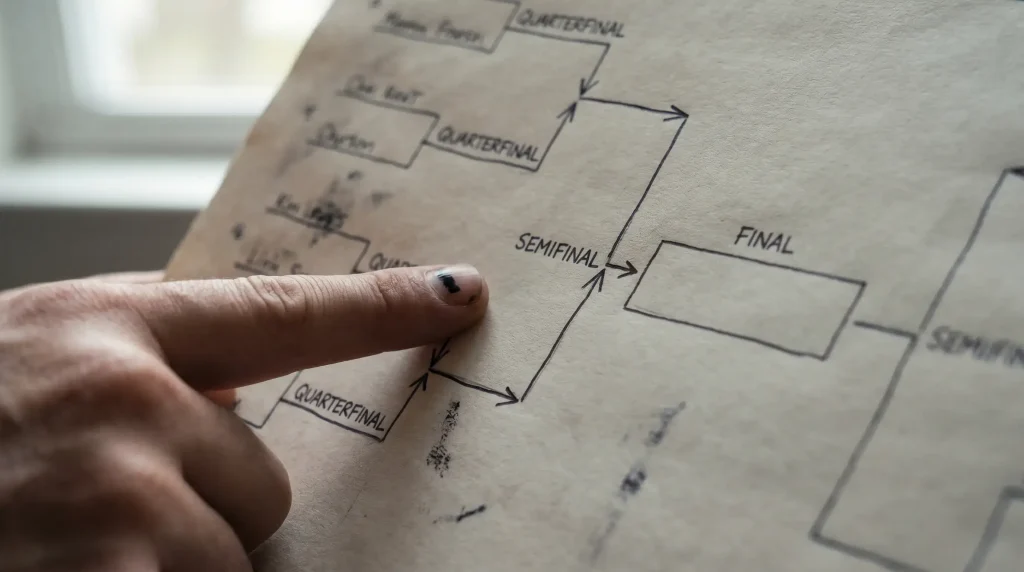
From the round of sixteen onward, the competition is a straightforward two-legged knockout, home and away, until the single-match final on neutral ground. Each tie is decided over 180 minutes of aggregate scoring, which changes the prediction calculus completely compared with the single matches of the league phase, because now teams are managing a two-game plan rather than chasing three points on the night. The bracket is largely set by seeding, so the higher-finishing teams are generally steered away from each other in the early knockout rounds, preserving the reward for a strong league phase.
For prediction, the play-off round is the most undervalued part of this ladder. The teams emerging from it arrive at the round of sixteen having played two extra high-intensity matches, while their seeded opponents have been resting and preparing, and that asymmetry in freshness and rhythm is a real factor that the raw quality comparison can miss. A play-off survivor riding momentum can be dangerous, but it can equally be running on fumes, and reading which is which is one of the first genuine edges the knockout phase offers.
The abolition of country protection
One rule change quietly reshaped the knockout draws, and it is the kind of detail that separates people who understand the modern competition from those still working off old assumptions. In the play-off knockout rounds, country protection has been removed, which means clubs from the same national association can now be drawn against each other at any stage, including early ones. Under the old system, domestic rivals were kept apart until late in the competition; now there is no such guarantee, and a team can meet a familiar league opponent in the round of sixteen.
This matters for prediction in a way that pure form analysis does not capture, because familiarity changes how matches play out. When two clubs from the same league meet in Europe, they know each other intimately, having played recently and repeatedly in domestic competition, and that shared knowledge tends to compress margins and reduce the tactical surprises that can swing a tie between strangers. A manager who has faced an opponent four times in two seasons brings a depth of preparation that a one-off European draw against an unfamiliar foreign side cannot match.

The practical consequence is that a same-association knockout tie should be read differently from a clash between teams meeting for the first time. The form table and the coefficient ranking still matter, but the familiarity factor adds a layer of caution to confident predictions, because well-drilled domestic rivals are harder to catch off guard and more likely to produce the cagey, low-margin contest that history between them has rehearsed. Knowing whether a tie pits familiar foes or genuine strangers is now part of the basic situational read, where once the rules made it irrelevant.
How the rules should reshape your read
Pulling these rules together changes how you should approach any knockout prediction, and the central shift is from predicting a match to predicting a tie. The two-legged structure means you are forecasting an aggregate outcome managed across two games, where game states, away trips and the running scoreline all feed into how teams behave, and the single-match instincts honed in the league phase actively mislead you here. This is also the stage where the difference between a casual forecast and a genuine recommendation bites hardest. As one analytics editorial team frames it, anyone can make a prediction, whereas a tip is usually given by experts and amounts to a specific recommendation on what to bet, and the unforgiving nature of a knockout tie is exactly where that higher bar earns its keep, because a loose prediction that ignores the aggregate structure will lead you badly astray.

The reason the bar rises so sharply is an asymmetry between the two phases. In the league phase, a bad result is absorbed by a long table; in a knockout tie, a bad ninety minutes can end the European season, so teams manage risk far more conservatively, and goal markets in particular tend to tighten as a result. The structure rewards the better, deeper, more experienced sides precisely because it punishes the single catastrophic error that an open league format would forgive, which is why knockout football so often sees the favourites grind through even when the matches are tight.
The durable lesson is to let the rules set your expectations before the teams do. Know which side skipped the play-off and arrives fresher, whether the tie pits familiar domestic rivals or strangers, and that you are pricing two legs rather than one, and you have already accounted for the structural factors most punters ignore in favour of surface form. All of this flows directly from where teams finished in the single table, so the knockout phase is best understood as the cash-out of the league phase, which I explain in full in my breakdown of how the Swiss-system league phase works.
Can two clubs from the same country meet in any round?
Yes. In the play-off knockout rounds, country protection has been removed, so clubs from the same national association can be drawn against each other at any stage, including the early rounds. Under the old format, domestic rivals were kept apart until late in the competition, but that guarantee no longer exists. For prediction this matters because same-league sides know each other intimately from domestic meetings, which tends to compress margins and produce cagier, lower-event ties than clashes between unfamiliar foreign opponents.
Which teams skip the knockout play-off?
The top eight clubs from the single league-phase table skip the knockout play-off and enter directly at the round of sixteen. This is a significant advantage, since it means two fewer high-intensity matches, fresher legs and less exposure to the variance of an extra two-legged tie. The teams finishing ninth to twenty-fourth must win a two-legged play-off to reach the round of sixteen, arriving with extra fatigue, while the clubs ranked twenty-fifth to thirty-sixth are eliminated from European competition entirely.
Articles
Created by the "Europa League Prediction" editorial team.
