
Europa League Quarter-Final Predictions: The Two-Leg Maths

 Available in US
Why a two-legged tie is a different sport from a single match
The first time I tried to predict a Europa League quarter-final the way I predicted a regular matchday game, I got it badly wrong, and the reason was simple. I was treating one leg as the event when the event was two legs stitched together. A quarter-final is not a match. It is a 180-minute negotiation with a running scoreboard, and the team that understands the negotiation usually beats the team that just plays well on the night.
The stakes sharpen the mind here. Reaching the quarter-finals pays a club around 2.5 million euros, and that money sits on top of everything earned in the league phase, so by this stage you are watching teams that have a great deal to gain and a coaching staff treating each leg as half of a single plan. That changes how they play, and any prediction that ignores the aggregate structure is predicting the wrong thing entirely.
So this piece is about the maths and the mindset of two legs: how aggregate thinking reframes a tie, how the first leg should reshape your read of the second, and how the sheer size of the prize bends team behaviour in ways the form table never shows.
Aggregate thinking changes what a result even means
In a one-off game, a 1-0 is a win and that is the end of it. Across two legs, a 1-0 away win can be a commanding position or a fragile one depending on how the second leg sets up, and the whole art of predicting a quarter-final is learning to think in aggregate rather than in individual results. The question is never “who wins this match” but “what does this result do to the state of the tie”.
This is exactly where punters who are good at single-match prediction stumble. The analysts at one accumulator-focused outfit put the contrast well: teams can afford an off day across an eight-match league phase, but the late two-legged knockout ties leave no room for error. That asymmetry is the heart of it. In the league phase a single bad result is absorbed by the table. In a quarter-final, a bad ninety minutes can end the European season, and teams know it, so they manage risk in ways that compress scorelines and reward caution.
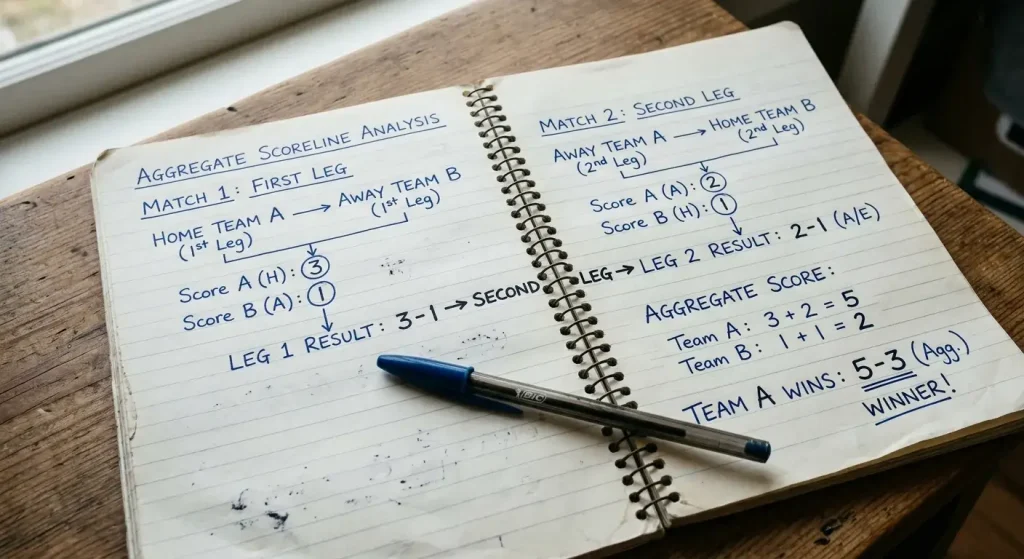
For prediction, the practical consequence is that goals markets behave differently across a tie than they do in isolation. A team protecting a first-leg lead will often trade attacking ambition for defensive solidity, dragging the goal expectancy of the second leg below what the two sides’ raw numbers would suggest. Read the tie as a single object with a current state, and you start to anticipate those shifts. Read each leg as a fresh match and you will keep being surprised by results that were entirely predictable once you accounted for the aggregate picture. The season’s overall scoring rate of 2.71 goals per match is a useful baseline, but it is a league-wide average that flattens exactly the cautious knockout behaviour that defines this stage.
How the first leg should rewrite your second-leg read
The first leg is not just a result. It is information that should substantially change the probabilities you attach to the second. The mistake is to walk into the return fixture with the same pre-tie expectations, lightly adjusted. The right approach treats the first-leg outcome as a new starting position that reshapes how both teams will play, which in turn reshapes which markets carry value.

Consider the game states. A team holding a comfortable two-goal aggregate lead going into the second leg has every incentive to sit deeper, slow the tempo and avoid risk, which tends to suppress goals and shift the realistic outcome toward a tight, low-event game. A team chasing a deficit must commit forward, which opens space, raises the chance of goals at both ends, and makes both-teams-to-score and over markets more live than the pre-tie picture implied. The same two teams produce completely different second legs depending on what the first leg did to the scoreboard.
The trap I see most often is over-respecting a narrow first-leg lead. A single-goal advantage feels decisive emotionally but is statistically fragile, because one goal for the trailing side levels the tie and flips the pressure entirely. Predicting the second leg well means pricing in how easily the state can change rather than assuming the first-leg leader will simply see it through. The strongest second-leg reads come from asking what each team needs from the game, deriving how that need will shape their approach, and only then settling on a market. Get the game state right and the rest tends to follow.
When the prize and the pressure distort the form book
There is a layer above the maths that decides more quarter-finals than people admit, and it is what the tie means to each club. Money and motivation are not soft factors here. They are the reason a mid-table side can summon a performance that its league form would never predict, because a European quarter-final represents a financial and reputational windfall it may not see again for years.

The managers feel it most. When Aston Villa’s run drew comparisons across the game, their head coach framed the ambition plainly, saying that going further would be another step forward, the kind of remark that sounds modest but reveals a squad treating the competition as a genuine target rather than a distraction. A team led by someone who has decided this is the season’s priority plays with a focus that does not show up in goal-difference columns, and a prediction that weighs only the numbers will keep underrating clubs whose whole campaign has narrowed to this one tie.

The flip side matters too. A club for whom the quarter-final is a bonus, with bigger domestic priorities, may quietly accept the risk of going out to protect a league push, and that ambivalence shows up as rotation and reduced intensity. Reading which side wants it more, and backing that read against a form book that cannot see desire, is one of the most reliable edges at this stage. The aggregate structure underpins all of it, and if you want the full framework for thinking across two legs in any round, my breakdown of the knockout phase rules that shape predictions lays out how the bracket itself drives these decisions.
How should a first-leg result reshape a second-leg prediction?
Treat the first-leg outcome as a new starting position rather than a minor adjustment. A team with a comfortable aggregate lead will usually defend it, suppressing goals and favouring a tight, low-event second leg, while a team chasing a deficit must attack, opening the game up and making both-teams-to-score and over markets more live. Be especially wary of over-trusting a single-goal lead, because one goal levels the tie and flips the pressure entirely.
What does reaching the quarter-final pay a club?
Reaching the quarter-finals is worth around 2.5 million euros, added on top of the participation payment and any results bonuses already banked during the league phase. That sum, and the prospect of more from a semi-final or final, is large enough to sharpen the motivation of clubs that might otherwise treat the competition as secondary, which is why the prize on the table belongs in your read of how hard a side will fight across the tie.
Articles
Created by the "Europa League Prediction" editorial team.
