
Europa League Winner Prediction: Reading the Outright Market

 Available in US
Why predicting the winner is a different game entirely
Every August I get the same message from punters: “Who’s winning the Europa League this year?” And every August I disappoint them by refusing to answer the way they want. Predicting a single match is a question about ninety minutes. Predicting the outright winner is a question about an entire season — thirteen or more matches, two-legged knockout ties, a draw nobody can see coming, injuries that haven’t happened yet, and a final on a neutral pitch. They look like the same question. They are not remotely the same question.
The outright market — betting now on who lifts the trophy in May — rewards a completely different kind of thinking. You’re not reading one fixture; you’re reading a club’s path through a tournament, its squad depth, its manager’s pedigree in this specific competition, and the cold arithmetic of how many ties it has to survive. The 2025/26 season is the perfect teacher here, because Aston Villa beat Freiburg 3-0 in the final in Istanbul to win it, and the way that result was foreshadowed — and the ways it wasn’t — contains nearly every lesson the outright market has to teach.
This piece is about reading that market like an analyst rather than a fan. I’ll walk you through how outright odds are built, dissect a real final to show what was predictable and what was variance, examine why a manager’s track record matters more here than almost anywhere in football, and lay out where genuine value tends to hide in the title market. By the end you’ll understand why “who’s going to win it?” is the wrong opening question — and what to ask instead.
How outright odds are actually built
A reader once told me he’d backed a midtable side for the title at long odds because “someone has to be the surprise.” That’s not a strategy, that’s a raffle ticket. Outright odds aren’t plucked from the air, and understanding how they’re assembled is the difference between buying a lottery ticket and making an investment.
An outright price is essentially the bookmaker’s estimate of a club’s probability of running the full gauntlet, converted into odds and loaded with margin. That probability is the product of many smaller probabilities multiplied together: the chance of topping or surviving the league phase, the chance of winning a play-off tie if required, then a round of sixteen, a quarter-final, a semi-final, and a final. Multiply a string of “likely but not certain” outcomes and the combined figure shrinks fast — which is why even a strong favourite to win any individual tie can be priced at healthy odds to win the whole thing. The maths of compounding is the single most important intuition in this market: surviving six hurdles in a row is much harder than clearing any one of them.
This is also why squad depth dominates outright pricing in a way it never does for a single match. A club playing knockout European football on Thursdays and a domestic league on Sundays needs two teams, not one. The favourites in the outright market are reliably the clubs with the deepest squads and the managers who rotate intelligently, because the title isn’t won by the best eleven — it’s won by the best twenty-five over a brutal nine-month schedule. When I assess an outright price, I’m not asking “are they good?” I’m asking “can they survive every round without their season collapsing in a fixture pile-up?” Those are very different questions, and the second one is the one the market is really pricing.


It’s worth understanding how the margin sits on top of all this, because it changes how you read an outright board. Add up the implied probabilities of every club to win the trophy and they total well over 100% — that overround is the bookmaker’s built-in edge, and it’s far heavier in outright markets than in single-match betting because there are so many runners to load. The practical consequence is that the longshots on an outright list are almost always worse value than they look: stretch a field of thirty-six clubs and the margin gets smeared most thickly across the bottom of the market, where casual punters reach for the romantic price. When you’re hunting value, you’re not just asking whether a club’s true chance beats its quoted odds — you’re asking whether it beats them by enough to clear a margin that’s working hardest against exactly the longshots that tempt people most.
The 2026 final as a case study in what’s predictable
I watched the 2026 final expecting a tight, anxious occasion and instead saw a masterclass that was effectively over by half-time. Aston Villa beat Freiburg 3-0 in Istanbul, and pulling that result apart tells you exactly which parts of an outright prediction you can lean on and which parts are simply football being football.
Start with what the scoreline reveals. Villa led 2-0 at the break through Youri Tielemans and Emiliano Buendía, then Morgan Rogers made it three early in the second half. That two-goal half-time cushion turning into a 3-0 win is not a freak — it’s a pattern. The three most recent Europa League finals decided by a two-goal half-time lead all finished 3-0, with Atlético in 2012, Atalanta in 2024 and Villa in 2026 all following the identical script. A side that takes command of a final early tends to manage the rest professionally; the occasion that looks most likely to be tense often becomes a procession once one team lands the first heavy blows. For an outright backer, the lesson is that finals are frequently won by the side that imposes itself first, and the clubs capable of doing that are exactly the deep, well-coached favourites the market already identifies.

Now the part that pricing struggles with. Villa’s win was their first Europa League title and their first European trophy in 44 years, since the European Cup of 1982 — a gap so long it ranks among the largest between major European finals for any English club, behind only Manchester City’s 51 years and West Ham’s 47. No outright model in the world prices in “this is the year a 44-year wait ends,” because that’s a narrative, not a variable. The club’s quality, squad and manager were all readable in advance. The romance was not. The discipline of outright betting is separating the genuinely predictive — quality, depth, coaching, draw difficulty — from the storylines that feel meaningful afterwards but couldn’t have informed a bet beforehand. The 3-0 was foreshadowed by the half-time lead. The 44-year wait was foreshadowed by nothing, and pretending otherwise is how punters fool themselves into backing fairy tales.
The manager factor the market keeps underrating
If you take one unconventional idea from this page, make it this: in the Europa League, the manager is a bigger predictive variable than in almost any other competition, and the market is slow to fully price it. I learned to weight coaching pedigree heavily here years ago, and the 2026 final was the loudest possible vindication.
Unai Emery won the Europa League for the fifth time in 2026 and became the first manager ever to win it with three different clubs — three times with Sevilla, once with Villarreal, and now once with Aston Villa. That is not a coincidence or a hot streak; it is a track record across two decades and multiple squads of wildly different quality. When the same man keeps winning the same trophy with whatever players he’s handed, he is telling you something the league table can’t: that he understands this specific competition — its rhythm, its two-legged ties, its Thursday-Sunday grind — better than almost anyone alive. As Olly Watkins put it after the win, he couldn’t speak highly enough of his manager, and that kind of buy-in from players is itself a competitive edge in a long campaign.
The pedigree was so obvious that Thomas Tuchel had remarked years earlier, back in 2021, that UEFA might as well rename the trophy after Emery — a line that reads as prophecy now but was, at the time, simply respect for a manager who’d cracked a competition others treated as a consolation. The practical takeaway for outright betting is concrete: when you’re weighing two clubs of similar squad quality, a manager with genuine pedigree in this exact tournament is worth shortening your own estimate of their price. Coaching that’s proven in two-legged European knockouts — managing a tie over 180 minutes, rotating for the league, peaking for May — is a repeatable edge, and repeatable edges are precisely what the outright market exists to reward. The market prices squads efficiently. It prices managers a beat slow, and that beat is where value lives.
Seeding, the draw, and the path to the final
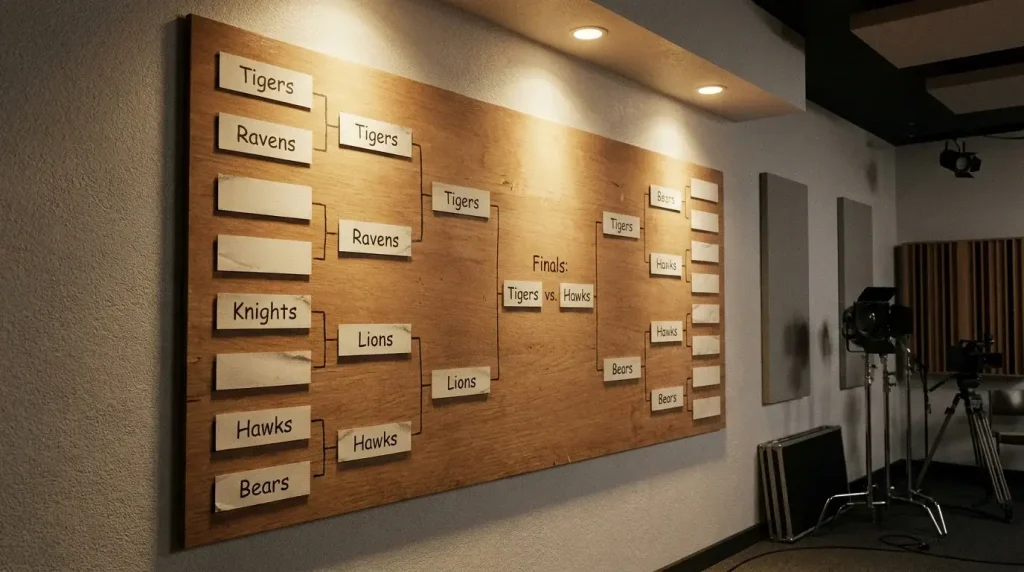
People obsess over which club is “best” and ignore the thing that often matters more: the draw. I’ve seen the strongest side in the competition handed a brutal path and the fourth-best handed an open one, and the open path is worth real money. Reading the bracket is half of outright analysis, and almost nobody does it properly.
The new league-phase format makes this readable in a way the old groups never were. The top eight finishers in the 36-team league phase go straight through to the round of sixteen, skipping the play-off round entirely, while sides finishing ninth to twenty-fourth must win an extra two-legged tie just to reach the same stage. That direct qualification is worth more than it looks: it spares a club two high-variance knockout matches, reduces fixture congestion at a punishing time of year, and means the top seeds arrive at the round of sixteen fresher and with one fewer chance to be ambushed. When I assess an outright bet early in the season, league-phase seeding is one of the first things I weigh — a club projected to finish in that top eight has a materially smoother path than one fighting through the play-offs, even if the two are similar in quality.
The draw’s difficulty compounds from there, and the format adds a wrinkle worth knowing: the old protection that kept clubs from the same country apart has been scrapped, so two English or two Spanish sides can now meet in any round, including early. That raises the chance of a marquee tie arriving before the final and a fancied club being knocked out by a domestic rival in the round of sixteen. For an outright backer, the instruction is to look past the name and study the road — who a club is likely to face, when, and how congested its calendar is around those ties. A smooth path can make a second-tier favourite into genuine value; a vicious one can make the nominal favourite a trap. None of this exists in a vacuum, either: the financial stakes attached to each round shape how hard clubs chase progression, and the prize money on offer climbs steeply enough through the knockout stages to change a club’s whole approach, which I’ve broken down in detail in a guide to how Europa League prize money shapes the competition.
Where the value actually hides in the title market
The single most profitable habit I’ve developed in the outright market is refusing to bet the favourite just because it’s the favourite. The shortest price is usually the most efficiently judged in the whole market — everyone can see the best team. Value lives where the crowd isn’t looking, and finding it is a craft worth learning.
Value in outrights tends to cluster in a few repeatable places. The first is the well-coached side priced on last season’s squad rather than this one — a club that’s strengthened quietly or hired a manager with real European pedigree, where the market hasn’t yet caught up. The second is the side with a soft projected path: a likely top-eight seed with a manageable half of the draw, priced as if it faces the same gauntlet as everyone else. The third is timing — outright prices move all season, and the sharpest value often appears not in August but after the league phase, when the draw is known and the bracket’s shape is visible but before the market has fully digested who got the kind road. As the analysts at Footy Accumulators observed, teams can survive an off day across the eight-match league phase, but the late two-legged ties leave no room for error, and that asymmetry is exactly why a club’s path matters so much: a strong side in an easy half is worth backing, while a strong side staring at three elite opponents in a row is a price to avoid however good it is.
What I never do is back a longshot purely on romance. The 2026 winner ended a 44-year wait, but it did so as a deep, superbly coached side that was a credible contender on quality alone — the fairy tale rode on top of genuine substance, it didn’t replace it. The discipline is to find the club whose true probability of surviving the gauntlet is higher than its price implies, for a reason you can name: better coaching than the market credits, a kinder path than the odds assume, or a squad upgrade the price hasn’t absorbed. Name the reason, or don’t make the bet. That single rule has saved me from more seductive longshots than I can count.

What to ask before you back a winner
When someone asks me who’ll win the Europa League, I now answer with questions of my own, because the questions are where the real analysis lives. Quality matters, but it’s the entry fee, not the edge. The edge is in the path, the coaching, the timing and the discipline to separate substance from story.
So here’s the framework to carry away. Outright odds are the compounded probability of surviving every round, which is why depth and a smooth draw matter more than raw quality. The manager is the variable the market underrates, especially in a competition one coach has now won five times with three clubs. Seeding and the scrapped same-country protection make the bracket readable, and a kind path can turn a second favourite into real value. And the unbreakable rule is that you back a price because you can name why it’s wrong — better coaching, an easier road, an unpriced upgrade — never because a fairy tale would be nice. As Unai Emery reflected after the 2026 win, his side had taken the whole campaign seriously and the players showed their desire — a reminder that the trophy goes to the team that treats every round as the hurdle it is. Predict the winner that way, and you’ll be reading a season rather than buying a raffle ticket.
How early in the season should you bet a Europa League outright?
There"s no single right moment, but the sharpest value often appears after the league phase rather than in August. Early prices are guesses about a path nobody can see yet; once the league-phase table and the knockout draw are known, you can judge which clubs got a kind road and which face a gauntlet, while the market sometimes lags in repricing. Backing in August means betting blind on the draw; waiting until the bracket is set lets you bet a club"s actual path, which is usually the better-informed wager.
Why does coaching pedigree like Emery"s matter for outright value?
Because the Europa League rewards a specific skill set — managing two-legged ties over 180 minutes, rotating a squad across a Thursday-Sunday schedule, and peaking for a one-off final — that some managers demonstrably master and others don"t. Unai Emery has won the competition five times with three different clubs, which is a repeatable track record across squads of varying quality rather than luck. The outright market prices squads efficiently but is slower to fully value proven coaching in this exact tournament, so a manager with real European knockout pedigree is often worth shortening your own estimate of a club"s price.
Does league-phase seeding predict who reaches the final?
It"s a meaningful factor rather than a guarantee. The top eight finishers in the league phase go straight to the round of sixteen, skipping the extra play-off tie that ninth-to-twenty-fourth-placed sides must win. That direct qualification spares two high-variance matches, eases fixture congestion and means top seeds arrive fresher with fewer chances to be ambushed. It doesn"t decide the final on its own, but a club projected for that top eight has a materially smoother path, which matters a great deal when you"re pricing its chance of surviving every round.
Articles
Created by the "Europa League Prediction" editorial team.
