
Predicting Two-Legged Ties: Aggregate Thinking

 Available in US
Learning to think in 180 minutes, not 90
The biggest mental shift any bettor makes when the knockout rounds arrive is learning to stop thinking about matches and start thinking about ties. A two-legged tie is not two separate games you predict independently; it is a single contest played across 180 minutes with a running aggregate, and the team that manages those 180 minutes best usually beats the team that simply plays well on one night. Get this framing right and the knockout phase opens up; cling to single-match instincts and you will be baffled by results that were entirely logical once you thought in aggregate.
The stakes make the structure worth mastering. Reaching the quarter-finals is worth around 2.5 million euros, and every round beyond that adds more, so by the knockout phase you are watching teams with a great deal to gain treating each leg as half of a deliberate plan. They are not chasing three points on the night; they are negotiating an aggregate scoreline across two games, and a prediction that ignores that negotiation is predicting the wrong thing.

So this article builds the aggregate mindset from the ground up: why thinking across two legs changes everything, how game states reshape how teams play, and why the trailing team’s second leg is the hardest thing in knockout football to price.
The aggregate mindset
The foundational idea is that in a tie, every result is provisional until the aggregate is settled, which changes what a scoreline even means. A 1-0 first-leg win is not a win in the way it would be in a single match; it is a small lead in an ongoing contest, and how valuable that lead is depends entirely on what comes next. Thinking in aggregate means asking not who won the leg but what the result did to the state of the tie, because the tie is the thing being decided, not the individual ninety minutes.
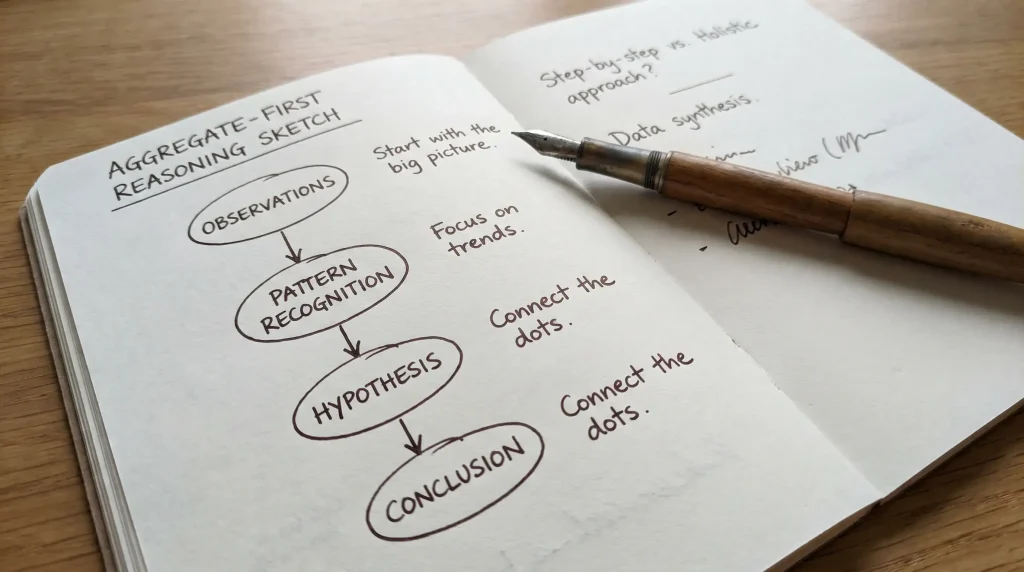
This is exactly where punters skilled at single-match prediction come unstuck, and the contrast is stark. The analysts at one accumulator-focused outfit put it well, observing that teams can afford an off day across the eight-match league phase but the late two-legged knockout ties leave no room for error. That asymmetry is the heart of the aggregate mindset. In a league format, a single bad result is absorbed; in a tie, a bad ninety minutes can be survived only if the other ninety repairs it, so teams manage the two legs as a connected pair, balancing risk across them rather than going all out in each.
The practical consequence is that the markets behave differently across a tie than they do in isolation. A team protecting an aggregate lead will trade attacking ambition for control, suppressing goals in a way its season-long numbers would never predict, while a team needing to overturn a deficit must take risks that open the game up. Read each leg as a fresh match and these shifts blindside you; read the tie as a single evolving object with a current state, and you anticipate them. The aggregate mindset is not a refinement of single-match thinking; it is a different way of seeing the contest entirely, and it is the prerequisite for everything else in knockout prediction.
Game-state effects
Game state, the current situation of the tie, is the engine that drives how teams play each leg, and learning to read it is the core skill of aggregate prediction. The same two teams will produce completely different second legs depending on what the first leg did to the scoreboard, because their incentives change with the state. A team leading on aggregate wants to control and protect; a team level wants to win without overcommitting; a team trailing must attack regardless of risk. The state dictates the approach, and the approach dictates which markets carry value.

Consider how this plays out across the goal markets. A team with a comfortable aggregate lead going into the second leg has every reason to sit deep, slow the tempo and minimise risk, which suppresses goals and pushes the realistic outcome toward a tight, low-event game where unders and no-both-teams-to-score become more likely. The same team, level on aggregate, plays a more balanced game; trailing, it throws caution aside, and suddenly the over and both-teams-to-score markets come alive because someone is forced to chase. The goal expectancy of a leg is not fixed by the teams’ quality; it is shaped by what the aggregate demands of them.
The modern competition adds a crucial wrinkle that changes game-state reading: away goals no longer count double. Under the old rule, a team’s behaviour was warped by the special value of scoring away from home, and protecting against conceding at home dominated tactical thinking. Without it, game states are cleaner and more intuitive, because a goal is just a goal wherever it is scored, and teams manage the aggregate purely on the raw scoreline rather than juggling the away-goals tiebreaker. This makes second legs somewhat easier to read than they once were, but it also means the old heuristics about away goals are now actively misleading, and predictions built on them will misfire.
Pricing the second leg
The hardest prediction in all of knockout football is the second leg of a tie where one team trails, and understanding why reveals the limits of aggregate thinking. A trailing team must attack, which sounds like it should make the leg predictable, but the chasing creates exactly the open, chaotic conditions that produce variance, and variance is the enemy of prediction. The team that needs goals commits players forward, leaves space behind, and turns the match into an end-to-end contest where either a comeback or a counter-attacking rout becomes possible, and pinning down which is genuinely hard.

The structural data points toward where the edge sits even amid that chaos. The eleven-season testing of a simple model found that profit came overwhelmingly from backing home teams while away bets were consistently loss-making, and that home edge interacts with the second leg in a specific way: a team chasing a deficit at home, roared on by its crowd and free of travel fatigue, is in the most favourable circumstances available to mount a comeback. A team trying to protect a lead away from home, by contrast, faces both the deficit-chaser’s intensity and the absence of its own home advantages. Knowing which team is at home for the decisive leg is therefore central to pricing it.

The realistic conclusion is that the trailing team’s second leg should be approached with humility and a preference for markets that respect the volatility. Rather than confidently predicting the comeback or the hold, the sharper read often lies in goal markets that account for the open, high-variance nature of a leg where one side must chase, or in resisting a confident outright call altogether when the situation is genuinely too chaotic to price. Aggregate thinking tells you why the leg is volatile; it does not always tell you who wins, and recognising that limit is itself a discipline. The aggregate framework here applies with particular force to the last eight, which I break down in detail in my piece on the two-leg maths of quarter-final predictions.
How does abolishing the away-goals rule change tie prediction?
It makes game states cleaner and more intuitive to read. Under the old rule, a goal scored away from home counted double in the event of an aggregate tie, which warped how teams played, especially in placing huge value on not conceding at home. With away goals abolished, a goal is just a goal wherever it is scored, so teams manage the aggregate purely on the raw scoreline. This makes second legs somewhat easier to predict than before, but it also means any heuristic built on the special value of away goals is now actively misleading and should be discarded.
Why is the trailing team"s second leg hard to price?
Because a team that must chase a deficit attacks heavily, and that chasing creates open, chaotic conditions that produce variance, the enemy of prediction. Committing players forward leaves space for the comeback and for a counter-attacking rout in equal measure, and pinning down which will happen is genuinely difficult. The home factor matters here: a team chasing at home, with its crowd and no travel fatigue, is in the best circumstances to come back, so which side is home for the decisive leg is central to pricing it, but even then the volatility often rewards goal markets over a confident outright call.
Articles
Created by the "Europa League Prediction" editorial team.
