
What Makes the Best Europa League Prediction Site?

 Available in US
The screenshot that taught me to distrust pretty tables
A few seasons back a reader sent me a screenshot of a prediction site that had picked seven Europa League winners in a row and asked whether he should follow it with his whole bankroll. I asked one question back: where does the site show the picks it got wrong? He couldn’t find them, because they weren’t there. That is the whole problem with judging a prediction site in a single glance. A clean table of green ticks tells you nothing, because you are only seeing the survivors. The losing weeks have quietly been swept off the page.

I have spent nine years building Europa League models and reading other people’s, and the gap between sites that look authoritative and sites that actually are has never been wider. The polished ones lean on volume and design. The honest ones lean on numbers you can check. When the best automated 1X2 forecasting in this competition currently runs at roughly 62 per cent over the last hundred matches, any site claiming a far higher hit rate is either measuring something different or hiding the matches that spoil the average. Knowing what 62 per cent feels like in practice is your single best lie-detector, because it tells you what good actually looks like before you trust anyone’s marketing.
So this is not a ranking of operators. I am not going to tell you which site to bookmark. What I will do is hand you the same checklist I use when a colleague asks me to sanity-check a service, so you can run the test yourself on whatever site you are looking at right now.
Criteria that separate a site worth reading from a sales funnel
Start with the question almost nobody asks: what is this site actually selling? Because every prediction site is selling something, even the free ones, and once you know the product you understand the incentives. A site that makes money from affiliate sign-ups wants you clicking through to a bookmaker, so its predictions skew toward exciting markets with long odds. A site that sells subscriptions wants you to feel that paying unlocks an edge, so it inflates the mystique of its method. None of that makes a site useless. It just means you read the picks with the incentive in mind.
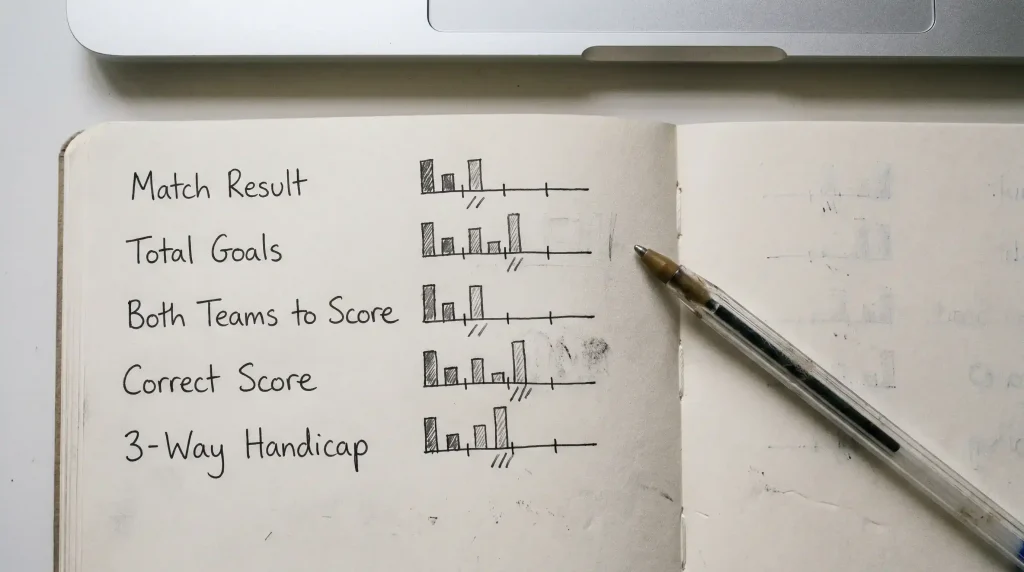
The first hard criterion is verifiable accuracy. A site worth your attention publishes its hit rate by market and lets you see the sample behind it. That distinction matters because accuracy is not one number. Both-teams-to-score and Over/Under 2.5 forecasts in the Europa League both sit around 50 per cent, which sounds unimpressive until you remember those are close to coin-flip markets where being right half the time still beats a careless punter. Correct-score forecasting, meanwhile, lands somewhere near 9 per cent. A site that quotes a single blended accuracy figure across all those markets is hiding the shape of its performance, and the shape is where the truth lives.
Second, look at whether the method is described in plain language. I do not need a site to publish its source code. I do need it to tell me whether predictions come from a statistical model, a human analyst, or a blend, and roughly what inputs feed them. A site that says “our advanced algorithm” and stops there is asking for faith. A site that says it uses expected goals, recent form over a defined window, and head-to-head with a stated weighting is at least giving you something to argue with.
Third, check the freshness and the context. The Europa League changed shape with the Swiss league phase, and any site still framing the competition around old group-stage logic is working from a stale map. Predictions that ignore which teams have already locked a top-eight finish, or which are scrapping to avoid elimination, are missing the motivation layer that often decides matchday outcomes. A good site connects the maths to the situation. A weak one prints a probability and walks away.
Red flags I treat as a hard stop
I once watched a tipster post a “guaranteed” Europa League accumulator and then, when it lost, quietly delete the tweet and post a new “guaranteed” treble the following Thursday. That memory hole is the reddest flag of all, so let me lay out the ones that make me close the tab immediately.

The word “guaranteed” is the first. Football prediction is probabilistic by nature, and anyone promising certainty is either ignorant of how variance works or counting on you to be. The honest framing is always about likelihood and edge, never about locks. The second flag is a track record you cannot independently verify. If results are self-reported, undated, or only visible after the matches have settled, treat them as marketing copy rather than evidence.
The third is selective memory, the screenshot problem from earlier. Watch how a site handles a bad week. The trustworthy ones leave the losing picks up and let the running record speak. The rest reset the scoreboard. A fourth flag is pressure: countdown timers, “only three spots left in the VIP group”, urgency tactics borrowed from worse industries. Genuine analytical edges do not expire at midnight. And a fifth, quieter one is the absence of any responsible-gambling messaging at all. A site that treats betting purely as a product to be maximised, with no acknowledgement that real people lose real money, has told you exactly how much it values its readers.
The transparency test you can run in five minutes
Here is the practical part. Open the site you are evaluating and try to answer three questions, timing yourself, because if a site genuinely respects evidence the answers are easy to find.
Question one: can you see the full record, wins and losses together, with dates? If the losing picks are buried, downgrade the site immediately. Question two: does the accuracy figure break down by market, and do those figures pass the smell test against what we know is realistically achievable? Correct-score claims above the low teens, for instance, should make you suspicious, because the market itself carries a structural distortion. Bookmaker odds show a statistically significant favourite-longshot bias on exact scorelines, meaning the prices on unlikely results are systematically too short. Any site claiming it routinely beats that market by a wide margin is fighting a well-documented edge that consistently defeats most who try.

Question three: can you tell who or what is making the prediction? A named analyst with a stated method, or a model with described inputs, beats an anonymous black box every time. None of these three questions requires you to be a statistician. They just require the site to have left the evidence in plain sight, which the good ones do as a matter of pride and the weak ones avoid as a matter of survival.
One last thing I tell everyone who asks. The best site for you is not necessarily the one with the highest headline accuracy. It is the one whose method you understand well enough to know when to ignore it. A prediction you can interrogate is worth ten you have to swallow whole, and once you have learned to read accuracy honestly you will find the same standard applies everywhere you look. If you want to go deeper on how those hit rates are actually measured and what the verified numbers really say, my full breakdown of how accurate Europa League predictions really are walks through the data market by market.

Should a prediction site publish its hit rate?
Yes, and it should publish it by market with the sample visible, not as a single blended figure. A site confident in its method shows the losing picks alongside the winning ones with dates attached. If the only numbers you can see are flattering and undated, treat them as marketing rather than evidence.
Are free tips less reliable than paid ones?
Not inherently. Free tips often exist to drive affiliate sign-ups or subscriptions, while paid tips carry the implication that money buys an edge, but neither price tag tells you anything about accuracy. Judge both by the same test: a verifiable record, a described method, and honesty about what the model gets wrong. Plenty of free analysis outperforms paid services that hide their results.
Articles
Created by the "Europa League Prediction" editorial team.
