
Europa League Scoring and Attendance Trends for Predictions

 Available in US
The season-wide numbers that anchor every match read
Before you predict a single Europa League match, you should know what a typical Europa League match looks like, and most punters never bother to find out. They dive straight into a specific fixture without any sense of the competition’s baseline, which is like estimating someone’s height without knowing the average for the population. The season-wide trends, how many goals the competition produces and how many people watch it, are the backdrop against which every individual prediction should be read, and ignoring them means working without a reference point.
The headline numbers are striking once you see them together. The 2025/26 season produced 189 matches and 512 goals, an average of 2.71 goals per match, while total attendance reached 4,954,145 spectators at an average of 26,212 per game. Those two figures, a healthy scoring rate and substantial crowds, tell you a great deal about the kind of competition you are predicting before you look at any single team, and they should shape your default assumptions about goals and home advantage.

So this article works through the trends that matter: what the goals-per-game figure tells you, what the attendance numbers mean for atmosphere and home performance, and how to translate season-wide trends into sharper individual predictions.
Goals per game
The 2.71 goals-per-match average is the single most useful number for anchoring a prediction, because it tells you the Europa League is a moderately high-scoring competition where goals are reasonably available. Derived from 512 goals across 189 matches, it sits comfortably above the 2.5 line that defines the most common goals market, which immediately tells you that overs are a reasonable default environment rather than a long shot. A competition averaging well under 2.5 would demand a sceptical eye on goal markets; one averaging 2.71 starts from a more open footing.

The value of the average is as a gravitational baseline that most matches drift back toward. Any individual fixture can finish goalless or end 5-3, but across a season the scoring rate is remarkably stable, which means a prediction that strays far from the baseline needs specific justification grounded in the two teams involved. If your analysis of a match produces a goal expectancy well below 2.5, you should be able to explain why this particular fixture is so much tighter than the competition norm, and if you cannot, the baseline is telling you your read is probably wrong.
The trend also varies by stage, which is where the season-wide figure becomes a starting point rather than a conclusion. The 2.71 average blends free-flowing league-phase matches, where teams are climbing a single table and dead-rubber caution is rare, with tense knockout ties where the cost of conceding rises and goals tend to dry up. A league-phase fixture between two ambitious sides will often clear the average comfortably, while a cagey first leg of a knockout tie may fall well below it. Knowing the overall rate is 2.71 lets you adjust intelligently for the stage rather than applying one blanket assumption to every match.
Attendance and atmosphere
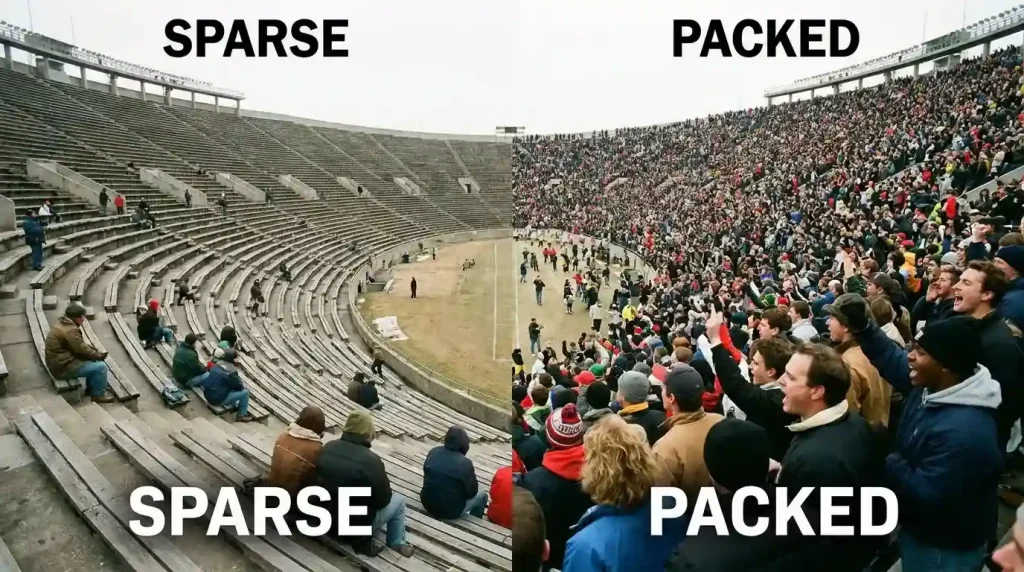
The attendance figures matter for prediction because crowds are part of home advantage, and the Europa League draws substantial ones. Total attendance of 4,954,145 across the season, averaging 26,212 per match, tells you these are not sparsely attended fixtures played in empty stadiums but well-supported matches with real atmospheres, and atmosphere is one of the mechanisms through which home advantage operates. A large, engaged home crowd lifts the home team and applies subtle pressure that can influence both players and officials, and average crowds above twenty-six thousand confirm that effect is in play across the competition.

The connection between crowd and performance is where this becomes a prediction input rather than a piece of trivia. Home advantage is one of the most robust findings in football, and the crowd is a core part of it, so a competition with healthy average attendances is one where home advantage should be expected to carry real weight. This dovetails with the broader evidence that backing home teams has historically been the profitable side of the market, and the substantial Europa League crowds are part of why the home edge in this competition is genuine rather than nominal.
There is also useful variation hidden in the average that rewards attention. The headline figure of 26,212 blends enormous crowds at the biggest clubs with more modest attendances at smaller ones, and the size and intensity of a specific home crowd is a factor worth weighing in a specific match. A club known for a fervent, packed home support brings more of the crowd-driven home advantage than one playing in a half-empty stadium, and that difference can tilt how much weight you give the home factor in a particular fixture. The season average tells you crowds matter in general; the specific attendance and atmosphere of a given match tells you how much they matter here.
What the trends mean for bets
Translating these season-wide trends into actual predictions comes down to using them as default settings that individual analysis then adjusts. The 2.71 goals-per-game baseline sets your starting expectation for goals, nudging you toward treating overs as a live default in open league-phase fixtures while remembering that knockout caution pulls the rate down, so you adjust by stage rather than betting the average blindly. The figure is the floor of your goals analysis, not its conclusion, and a specific match read should move you off the baseline only with a specific reason.

The attendance trends set your default respect for home advantage, confirming that the crowd-driven home edge is real across the competition and should feature in every match read, while the variation in crowd size lets you dial that respect up or down for specific fixtures. A home team backed by a large, intense crowd warrants more deference to the home factor; one playing in front of a sparse attendance warrants less. These are not separate considerations from the goals baseline but complementary ones, because home advantage and goal expectancy together shape the most fundamental predictions you make.
The durable principle is that good prediction starts from the competition’s baselines and adjusts toward the specific match, never the other way round. Knowing the Europa League produces 2.71 goals per game and draws crowds averaging over twenty-six thousand gives you a calibrated starting point that keeps your individual predictions grounded, so that when a match read diverges sharply from the norm you treat that divergence as a claim requiring evidence rather than an assumption. The goals baseline feeds most directly into the totals market, which I cover in detail in my guide to predicting the Over/Under 2.5 goals line.
How many goals per game does the Europa League average?
The 2025/26 season averaged 2.71 goals per match, derived from 512 goals across 189 matches. That figure sits comfortably above the 2.5 line that defines the most common goals market, which tells you the competition is moderately high-scoring and that overs are a reasonable default environment rather than a long shot. The average is best used as a gravitational baseline most matches drift toward, with the important caveat that it blends free-flowing league-phase fixtures with tighter knockout ties, so you adjust for the stage rather than applying one blanket figure to every match.
Does crowd size correlate with home performance?
Crowds are a core part of home advantage, which is one of the most robust findings in football, so a competition with healthy attendances is one where the home edge carries real weight. The Europa League"s average attendance of 26,212 per match confirms the crowd effect is in play across the competition, and this dovetails with the evidence that backing home teams has historically been the profitable side of the market. The headline average also hides variation, so a club with a large, intense home support brings more crowd-driven advantage than one playing before a sparse attendance.
Articles
Created by the "Europa League Prediction" editorial team.
